Article
The Distribution of Ducks on a Pond
On this page 4
Question
Ducks are uniformly distributed on a large pond. What is the probability that a duck is its nearest neighbor’s nearest neighbor?
Answer
Interpreting the Problem
The key is to construct the right probabilistic model.
Suppose the two ducks being tested for mutual nearest-neighbor status are A and B, with . In a pond where ducks are uniformly distributed, the probability that A and B are mutual nearest neighbors decreases as grows. If we can express this probability as a function , an integral will give the expected probability of mutual nearest-neighbor status.
The problem can therefore be restated as follows:
Ducks are uniformly distributed. Consider ducks A and B at distance —itself a probabilistic event—find the probability that they are nearest neighbors under this condition, and then take the expectation.
Equivalently, use this procedure:
- Choose a central duck A.
- Find A’s nearest neighbor B and calculate the density for their distance.
- For this B, calculate the probability that A is also B’s nearest neighbor.
- Integrate the product .
The first three steps are equivalent to calculating .
Modeling
How do we obtain this probability? The only information available is uniformity, so let the constant density be . What is the probability that a region of area contains no ducks?
Divide the region into infinitely many tiny cells. The probability of a duck occupying any one cell approaches zero, while the expected total remains the constant . This is exactly a Poisson distribution.
A Poisson distribution describes the number of times a random event occurs in a fixed interval of time or space. Its defining features are that events occur independently, randomly, and at a constant average rate.
It is the limiting form of the binomial distribution .
Here, and . Therefore and .
Differentiating gives the density . The quantity is the probability that the distance lies in , which can be viewed as the infinitesimal analogue of .
We now have . The next step is , the probability that A is also B’s nearest neighbor.
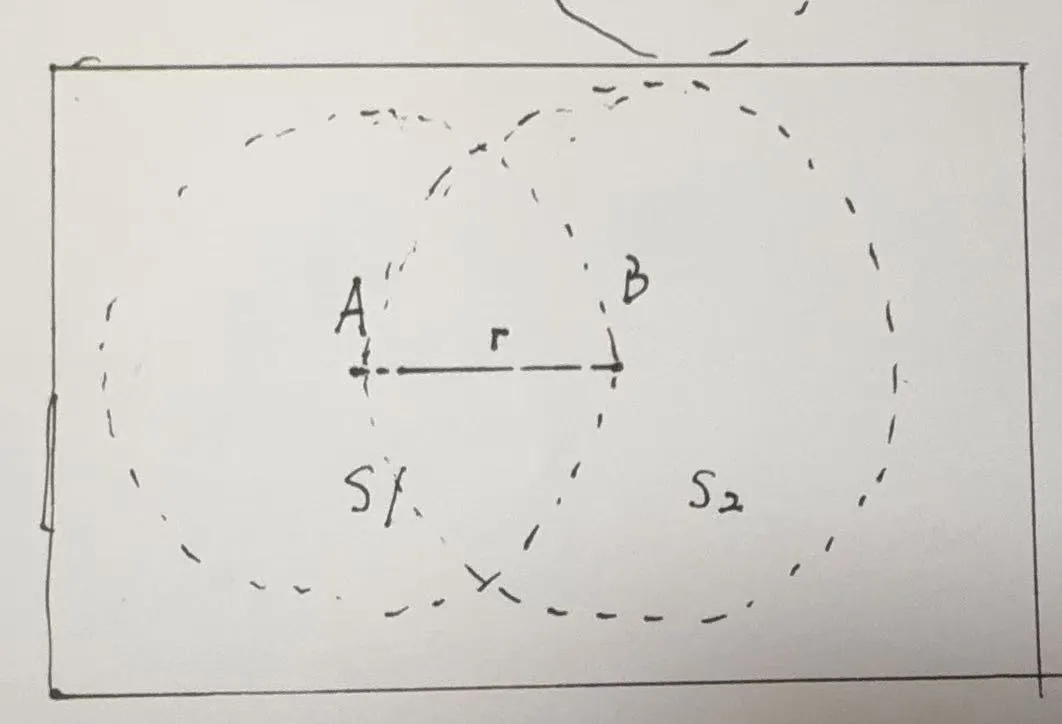
In the diagram, the radius- neighborhood around A is already empty. For A to be B’s nearest neighbor, only the crescent-shaped region on the right must also contain no ducks. We need only calculate its area and substitute it into the probability formula; under a uniform distribution, the shape itself does not matter.
Finally, multiply and and integrate:
Substituting all values gives .
Another observation: the exponent in the integrand corresponds to , the total area. Geometrically this is the figure-eight union of two overlapping circles of radius , and the expression gives the probability that this union is empty.